















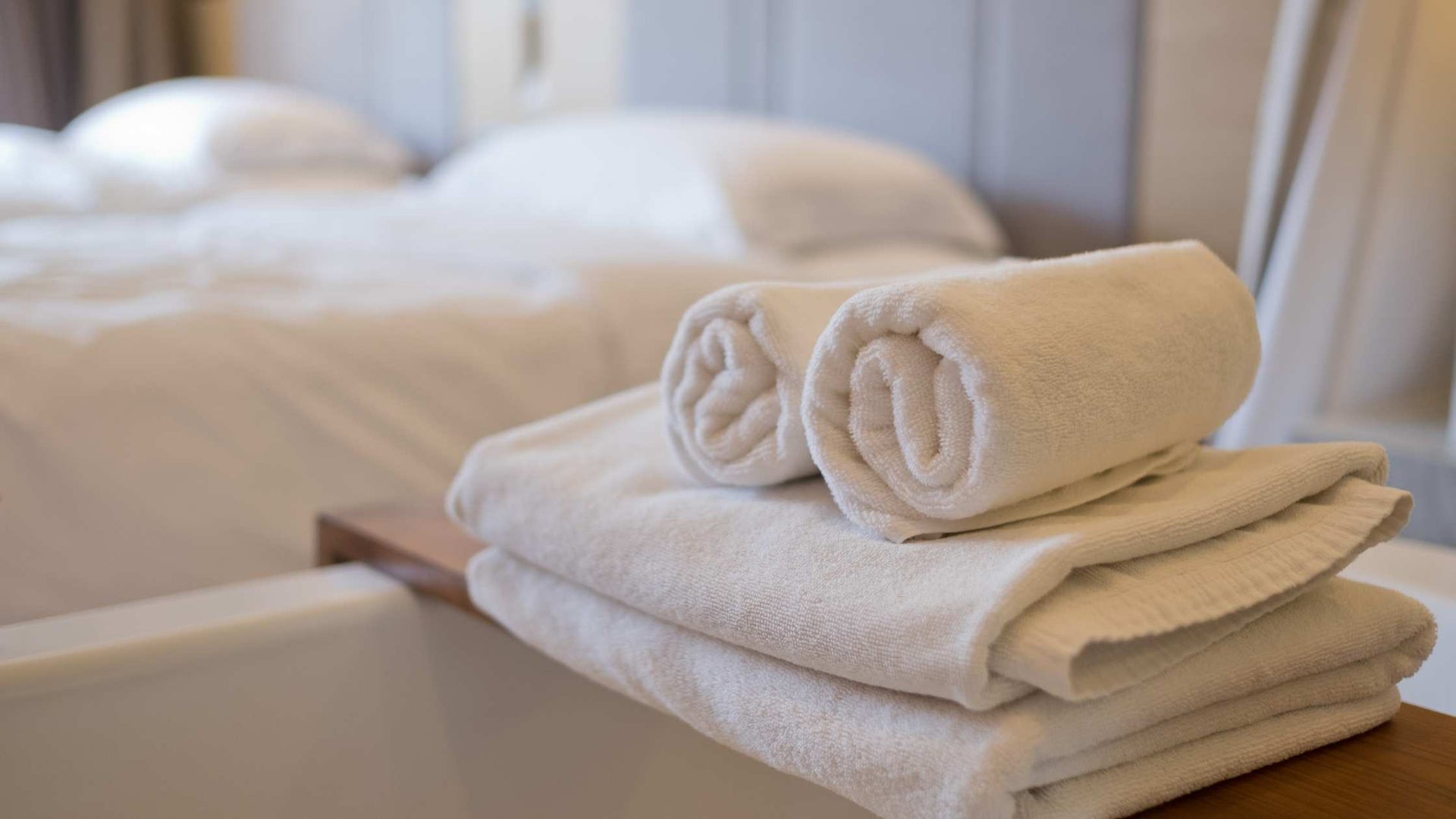
To choose a bathrobe, start with how you will use it: terry cotton of 400 to 500 g/m² to dry off properly after a shower, a lighter waffle weave for summer or travel. Then pick the collar (shawl, hood or kimono), choose the size from your chest measurement and settle on the length that suits you.
This article is part of our guide How to choose bath linen?.
What is a bathrobe for?
A bathrobe replaces or complements a bath sheet: it absorbs moisture from your skin while keeping you warm, with your hands free. Depending on your habits, you will mainly want it to:
- dry you, straight after a shower or bath: absorbency comes first;
- wrap you up, to lounge at home: softness and weight matter more;
- be practical, for the pool, the gym or travelling: a light fabric that dries fast and packs easily is best.
Bathrobe fabric
Cotton remains the reference: it absorbs well, withstands regular washing and gets softer over time. It is mainly the weave that changes the feel.
- Terry cotton: loops on both sides, very absorbent and plush. The classic after-bath robe, though it takes longer to dry.
- Waffle: a textured, flatter and lighter weave. It absorbs well enough, dries quickly and takes up little space; ideal for summer, the gym or travelling.
- Velour: terry on the inside, a sheared, smooth and soft face on the outside. It looks smarter; absorption happens mainly on the inside.
- Cotton gauze or linen: light, breathable robes designed for warm climates rather than heavy drying.
- Microfibre or fleece: very warm and light, but much less absorbent than cotton; they work better as a dressing gown.
What weight for a bathrobe?
Weight, expressed in g/m² (GSM), tells you how much fabric there is. The denser the robe, the thicker, more absorbent and warmer it is, but also heavier and slower to dry. The principle is the same as for towels, explained in our article on bath towel weight.
| Weight | Feel | Best for |
|---|---|---|
| 200 to 300 g/m² | Light, often waffle | Summer, travel, sport |
| 300 to 400 g/m² | Supple, dries fairly fast | Daily use, mild climate |
| 400 to 500 g/m² | Thick and absorbent | After the bath, all year round |
| Over 500 g/m² | Very plush and warm | Comfort lovers, well-ventilated home |
A high weight is not always the best choice: in a bathroom without a window, a very thick robe can stay damp for a long time.
Shawl collar, hood or kimono?
The shawl collar
The most classic option: a wide collar that folds around the neck and runs down to the belt. It keeps the back of your neck warm and is easy to wear around the house.
The hood
Handy for drying your hair without an extra towel, it is popular with children, swimmers and anyone leaving the pool or steam room.
The kimono collar
A flat, straight collar that looks lighter and is less bulky. It is often found on waffle, gauze or velour robes, and packs more easily into a suitcase.
How to choose bathrobe size?
Take a tape measure and measure your chest at its fullest point, arms by your sides. The figures below are a guide and may vary with the cut: always check the size guide for the model.
| Size | Approximate chest |
|---|---|
| S | 88 to 96 cm |
| M | 96 to 104 cm |
| L | 104 to 112 cm |
| XL | 112 to 120 cm |
| XXL | 120 to 128 cm |
Women's and men's bathrobes
Many bathrobes are unisex. A women's cut is usually shorter and more fitted at the shoulders, a men's cut longer and wider. If you are between two sizes, go for the larger one: a robe is worn loose, wraps generously at the front, and terry cotton can shrink slightly in the first washes.
Children's bathrobes
For children, size is chosen by age and build, with some room to grow so they can wear it for several seasons. Our guide children's bathrobe sizes by age gives the benchmarks.
Which length to choose?
- Short, above the knee: light, easy to move around in, popular in summer.
- Mid-length, at the knee or mid-calf: the best balance between warmth and freedom of movement.
- Long, down to the ankle: the most enveloping, for winter or those who feel the cold.
Compare the length given in centimetres with your height: on someone 1.70 m tall, a robe of around 110 cm usually falls just below the knee.
The details that make a difference
- a belt long enough, held by loops so it does not go missing;
- patch pockets, handy every day;
- neat seams and hems that stand up to washing;
- a hanging loop so the robe can dry on a hook.
A well-cared-for bathrobe stays soft for years: our tips on washing a bathrobe without damaging it cover temperature and drying. To compare the styles, colours and sizes available, browse our selection of bathrobes.
In summary
Choose the fabric first according to use: terry cotton of 400 to 500 g/m² to dry off well, light waffle for summer and travel, velour for a smarter look. Then go for a shawl collar, a hood or a kimono collar, measure your chest with a tape measure to find your size, going up a size if in doubt, and pick a short, mid-length or long robe depending on how much you feel the cold.
