To choose the right bedding, pick your duvet according to how warm you sleep (weight and filling), your pillow according to your sleeping position, and protect everything with a mattress protector and pillow protectors. These three elements, duvet, pillow and protectors, determine both the thermal comfort and the hygiene of your bed.
This guide gives you the key points for each one and points you to our detailed articles.
How to choose a duvet
The ideal duvet keeps you warm without making you sweat. Four criteria matter: the filling, the weight, the shell and the size.
Natural or synthetic duvet?
A natural duvet, filled with duck or goose down and feathers, is light, lofty and highly insulating: it provides plenty of warmth for very little weight and regulates moisture well. On the other hand, it needs more careful maintenance.
A synthetic duvet, made of polyester fibres, is easy to care for (machine washable at 40 or 60 °C), dries quickly and suits people who are sensitive or allergic to feathers. It is the practical choice for family use.
Which weight for which season?
A duvet's weight, in g/m², indicates the amount of filling and therefore how warm it is:
| Type of duvet | Weight (synthetic) | Season |
|---|---|---|
| Light duvet | About 200 g/m² | Summer, warm bedroom |
| Medium-weight duvet | About 300 g/m² | Spring and autumn, all year round in a heated bedroom |
| Warm duvet | 400 g/m² and more | Winter, cool bedroom |
A natural duvet needs a lower weight for the same warmth, because down insulates better. If you want a single duvet for the whole year, the 4-season duvet, made of two duvets that you join together in winter, is a good solution. Discover our summer and winter duvets.
Shell and stitching
A tightly woven cotton shell is soft and breathable, and it stops the filling from escaping. The stitching, which holds the filling in place, prevents it from bunching up on one side. A well-stitched duvet keeps an even warmth across its entire surface.
What size duvet?
Choose a duvet about 50 to 60 cm wider than the mattress so that it falls over each side: 140x200 cm for a single bed, 220x240 cm for a 140 or 160 cm bed, 240x260 cm for a king-size bed. Find all the details in our guide to duvet sizes.
How to choose a pillow
A pillow should keep your head in line with your spine. The right choice depends mainly on your sleeping position:
- On your back: a soft to medium-firm pillow of medium thickness.
- On your side: a firm, thick pillow that fills the gap between your shoulder and your head.
- On your stomach: a very soft, flat pillow so your neck doesn't arch.
The filling matters too: feathers and down for a pillow that moulds to you, synthetic fibres for a pillow that is easy to wash, memory foam for precise support. If you suffer from pain, read our article on the best pillow for neck pain. As for format, the 65x65 cm square pillow is the most common in France, while the 50x70 cm rectangular one fits more easily on a double bed. See our pillows.
Protecting your bedding: mattress protector, waterproof mattress pad and pillow protector
Protectors extend the life of your bedding and improve the hygiene of your bed. They are easy to wash, unlike a mattress or a pillow.
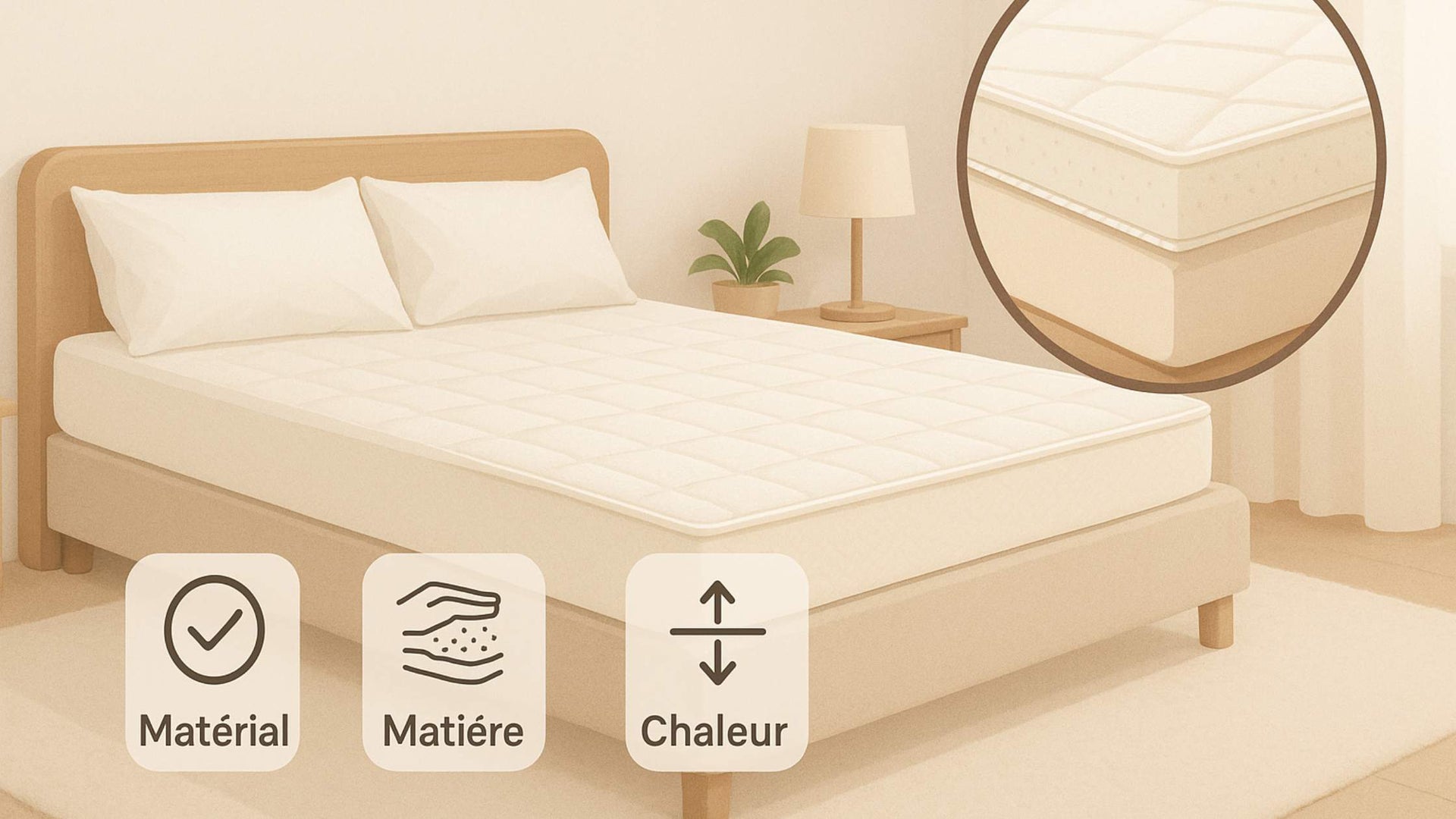
- The mattress protector guards against stains, sweat and wear. A quilted model adds comfort, a waterproof model stops liquids.
- The waterproof mattress pad is especially useful for children and the elderly. Read our article on waterproof mattress pads.
- The pillow protector goes under the pillowcase and stops the pillow from yellowing with sweat.
Make sure you choose the right size, taking the thickness of your mattress into account: see how to choose the size of your mattress protector. Discover our bedding protectors.
Mattress and mattress topper: the foundation of comfort
A duvet and a pillow cannot make up for a worn-out mattress. A suitable mattress supports your back without creating pressure points; a mattress topper can bring softness back to a mattress that is too firm. Our articles which mattress to choose for back pain and how to choose a mattress topper will help you take stock.
When should you replace your duvet and pillow?
A synthetic duvet should be replaced every 5 to 10 years; a good-quality natural duvet can last longer. A pillow should be changed every 2 to 3 years: if it no longer springs back when folded in half, or if it has yellowed despite washing, it is time. To care for them, see how to wash a duvet and how to wash a pillow.
In summary
A duvet with the right weight for your bedroom, a pillow suited to your sleeping position and washable protectors: that is the combination for comfortable, healthy and long-lasting bedding. Complete it with bed linen in a fabric you love, using our guide to choosing bed linen.
All our articles: Duvets, pillows & protection
- Mattress protector
- How to choose a mattress topper well?
- Which mattress to choose to relieve back pain?
- Which pillow to choose for neck pain?