















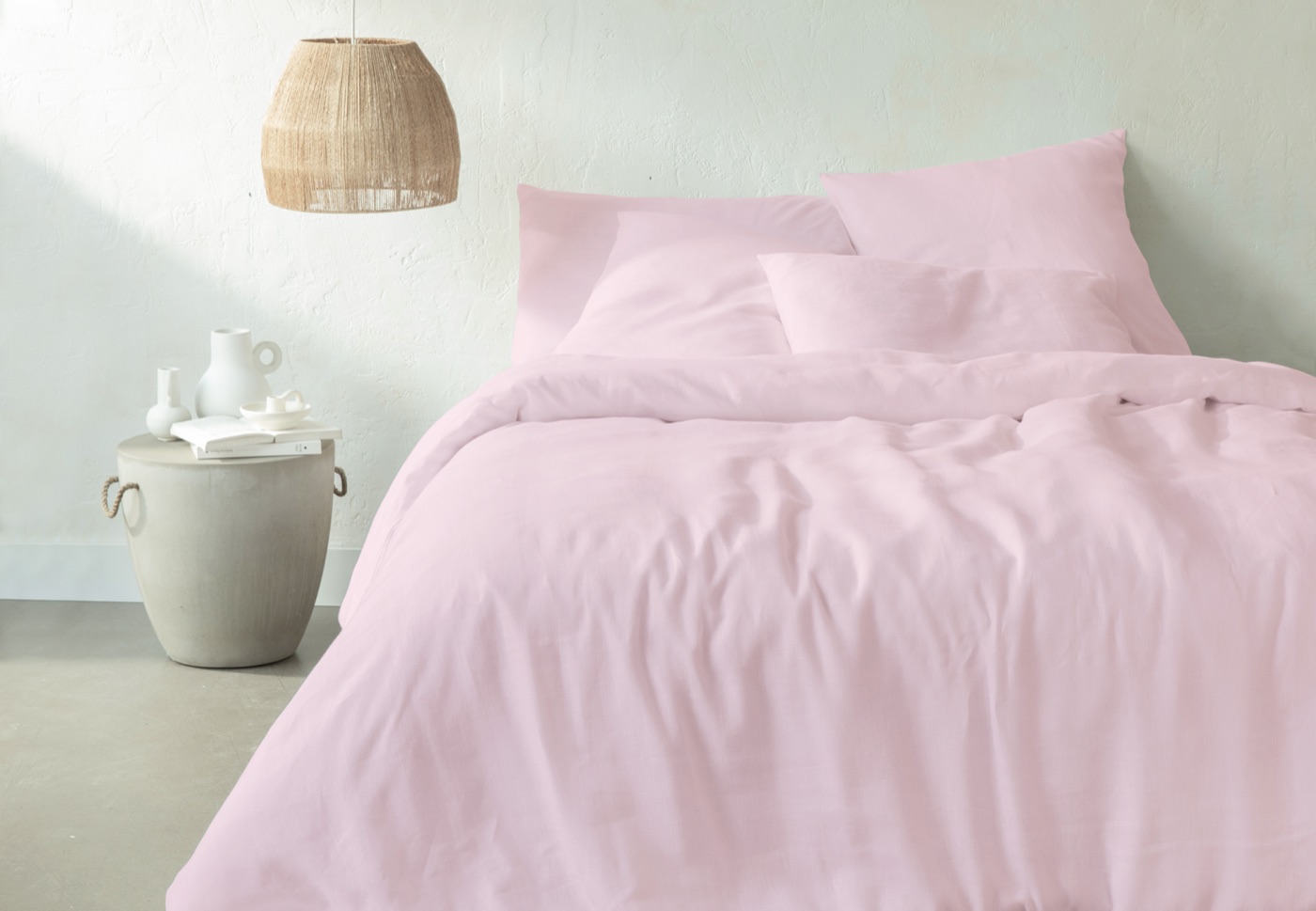
To fold a duvet cover, close it, lay it completely flat, fold it in half or in three lengthwise to get a strip as wide as your shelf, then fold that strip in three or four. Always work on fully dry fabric, ideally straight after drying, to keep creases to a minimum. You end up with a neat rectangle that stacks without slipping.
This article is part of our guide Household Linen Care: The Complete Guide.
This guide is part of our feature on folding and storing household linen. It works for every size, from a 140x200 single duvet cover to a 240x260 one for a large bed: only the width of the first folds changes.
What you need
- a clean duvet cover that is completely dry, seams and corners included;
- a flat, clean surface: the bed, a table or a clear floor;
- possibly a second person for large sizes (240x260 and above);
- the width of your shelf in mind, to size the folds.
Step by step
- Close the cover: buttons, press studs or zip. Closed, it keeps its shape and the two layers do not slide over each other.
- Turn it right side out and spread it on the bed or a table, smoothing the fabric with the flat of your hand to remove creases.
- Fold it in half lengthwise, edge to edge, corners aligned. For a large cover, fold in half again or bring the sides in by thirds towards the centre.
- Adjust the strip to the width of the shelf: about 30 to 40 cm for a standard wardrobe.
- Fold the strip in three or four starting from one end, smoothing each fold.
- Store it opening or fold facing forward, whichever you prefer, but always the same way: the stack stays easy to read.
With two people, for a large cover
Each person holds two corners of the same short side, with the cover closed. Pull the fabric taut, come together to fold it in half lengthwise, then one person brings their corners to the other. Lay the strip on the bed and finish the folds flat. Shaking the cover out before you start removes a good share of the creases.
By fabric
- Cotton percale: matt and crisp, it holds folds well; fold it by hand while still slightly warm from drying and smooth each fold.
- Cotton sateen: more slippery, it folds better when closed and flat, without pulling on the seams.
- Washed linen: its rumpled look is part of its charm, so there is no need for razor-sharp folds. Fold it loosely without packing the stack too tight. See our washed linen collection.
- Cotton gauze and flannel: lofty fabrics; fold in three rather than four to avoid bundles that are too thick.
Mistakes to avoid
- Folding a cover that is still damp: trapped moisture causes a musty smell and can lead to mould.
- Leaving the cover open: the two sides slide, the fold loses its shape and the stack collapses.
- Pressing too hard: a compressed stack sets deep creases that are hard to remove without an iron.
- Folding to different sizes: bundles of varying sizes stack badly. Keep one format per shelf.
Store the cover with its set
Once folded, the cover can be stored with the sheet and one pillowcase inside the second pillowcase of the same set: that is the trick for storing bedding sets inside a pillowcase. On changing day, our method for putting on a duvet cover makes the next step easier. If you are looking for a new one, our range of duvet covers comes in all standard sizes.
Frequently asked questions
Should you iron a duvet cover before folding it?
It is not necessary. Shake it out when it comes out of the machine, dry it flat or pulled taut, and fold it as soon as it is dry: it stays neat. Ironing is an aesthetic choice, not a must.
How do you fold a duvet cover so it takes up little space?
Fold it in three lengthwise rather than in two, then roll the strip instead of folding it. The roll takes little room in a drawer or suitcase and sets fewer creases than tight folding.
Can you fold a 240x260 cover on your own?
Yes, by working flat on the bed: close it, spread it, fold one side to the middle, then the other, and fold the resulting strip in four. It is slower than with two people, but the result is the same.
In summary
A duvet cover is folded closed, fully dry and flat: in strips lengthwise to the width of the shelf, then in three or four. Use the same format for all your covers and do not pack the stack tight: your cupboard stays tidy and the linen comes out almost crease-free.



